

Longmont’s Cost of Living Leaves Young Families on a Razor’s Edge
Longmont’s government has the power to reduce the cost of living for every day Longmonters. We just need to exercise that power. The way the choices of local government drive up cost of living might seem hard to find, but you see them in your every day life.
Young Families Live on a Razor’s Edge
The average young family in Longmont makes $96,771 and has 2.4 people. This is close to the US average. 1Nationwide average is $89,603, local data not available. Longmonters aged 25 -44 make about 8% more than the average American the same age, so we’ll say a Longmont household 25 – 34 makes $96,771 The average American spends most of their money on housing, transportation and food.2Bureau of Labor Statistics
Let’s break down the monthly expenses:
- Housing: $2,600 per month Because Longmont has failed to build enough homes for everyone who needs one, housing in Longmont is expensive. Our young household definitely rents — increasing home prices nationwide have pushed up the average age of first time home buyers from 30 to 38.3National Association of Realtors Profile of Home Buyers Young households spend 32% of their income on rent4US Census Bureau — it’s also worth noting that this average is drug down artificially. 29% spend less than 20% of their income, 41% spend more than 35%.—above the 30% threshold considered “rent burdened.” They’re not alone – 61% of households of all incomes and ages in Longmont are rent burdened, compared to 48% nationwide.
- Transportation: $2,000 per month Most Longmont households with two adults have two cars.5Census Table B08201 A lack of high quality transit options within Longmont and to other nearby cities mean that there’s rarely an alternative. This is compounded by the fact that half of Longmont residents work outside the city.6City of Longmont Even with used vehicles, fuel, insurance, and maintenance costs run about $1,000 monthly.7AAA provides data for new car ownership costs. I’m assuming that a used car costs what a new car costs for fuel, insurance and maintenance. This might be a little high, but probably not by much since used cars typically need more maintenance than new.
- Childcare: $1,364 per month For families with young children, childcare at one of Longmont’s highest quality, most affordable providers costs $1,364 monthly.8The Longmont Y This is more than the national average of $750 per month for young children9Department of Labor, average of infant and toddler care in counties of comparable population
- Food: $625 per month A household making just under the median income will spend about $625 monthly on food.10US Department of Agriculture
These four expenses alone total $79,000 annually – the entire income of our example family after income taxes. This leaves nothing for health insurance, emergency savings, retirement, or a down payment on a home.
This precarious financial situation isn’t limited to young renters. Seniors who bought homes decades ago may find themselves house-rich but cash-poor, unable to find suitable smaller housing options in the neighborhoods where they’ve built community.
Measurable Solutions That Work
We can reduce the cost of housing and transportation by designing Longmont to make living more affordable. By implementing proven policies, we can create measurable improvements:

- Housing Affordability: By allowing missing middle housing in all neighborhoods, we can add more naturally affordable homes for sale AND for rent. This creates an accessible pathway to home ownership and increases competition among landlords, which will bring rents down.11We’re starting to see the effects of this on rent in Denver, where some landlords are offering 10 weeks of free rent to entice people to move
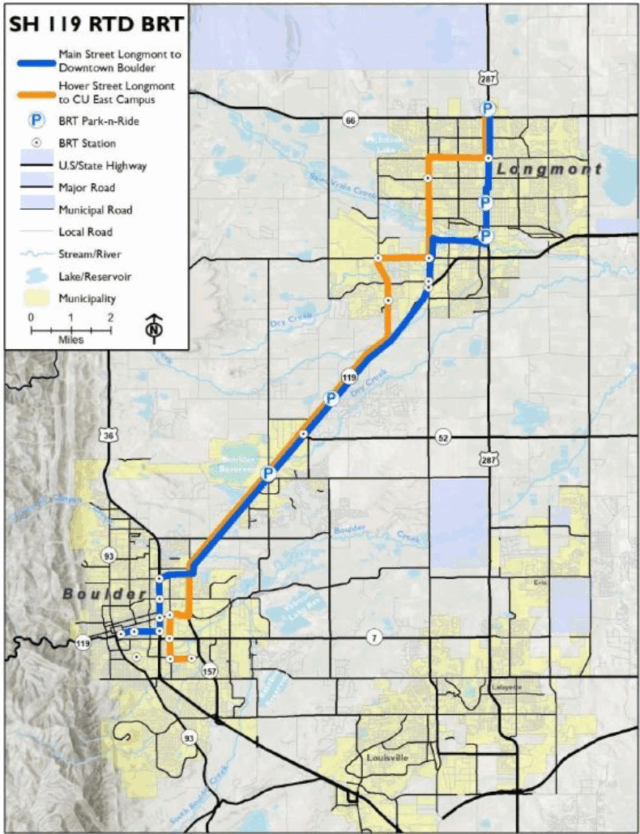
Planned routes for bus rapid transit between Longmont and Boulder. - Transportation Costs: Starting in 2027, we’ll have convenient to use bus rapid transit between Longmont and Boulder. These busses will travel at 30 minute frequency, and with dedicated lanes along CO-119, meaning they’ll go faster than traffic. This will save money for the 41% of Longmonters who commute to Boulder, reducing their commuting costs by $1,171 per year.12Assumes that fuel costs $0.149/mile and maintenance is $0.1013/mile (AAA), and that 3 commuting trips per week which would be done by car are replaced with BRT. It will also reduce traffic for those who choose to drive (saving time). The nearly-free shuttle service Ride Longmont is helping people save money and reducing traffic too, by giving people a public transit option that works with our car-centric city design.
- Neighborhood Services: Current zoning laws ban all kinds of essential services from our neighborhoods, which doesn’t make sense because that’s often where we need them the most. Life would be better if we could go to the doctor, take the kids to day care, pick up some groceries and get a cup of coffee for the morning dog walk without having to get into a car. Allowing small-scale, neighborhood focused businesses in residential areas can reduce daily travel needs13Most trips are less than 6 miles, and most non-work related trips are to social, school or shopping, US Department of Energy. while creating walkable communities where children, working adults, and seniors all thrive.
Preserving What Makes Longmont Special
These changes won’t erode Longmont’s character – they’ll enhance it. By creating more housing options, we allow multiple generations to live in the same neighborhoods. By building safe walking and biking infrastructure, we create streets where neighbors interact, children play safely and it’s not necessary to use a car to get everywhere. By allowing neighborhood businesses, we rebuild the community connections that defined Longmont’s past.
For longtime residents, these policies provide options to age in place without leaving beloved neighborhoods. For young families, they create pathways to stable housing and financial security. For everyone, they mean less time stuck in traffic and more time enjoying what makes Longmont special.
Measuring Success
As mayor, I’ll implement these proven solutions and measure success by:
- Reduction in housing cost burden percentage
- Decrease in average commute times
- Increase in walkability scores across all neighborhoods
- Growth in number of Longmont residents who both live and work in the city
- Improved affordability metrics for all age groups

One comment
Mary
May 17, 2025 at 4:40 pm
I love to see someone trying to preserve community character while making it a better place for everyone who lives there. Everyone should be able to afford a home!